Educational only — not audit or tax advice. Every organization's engagement letter and scope will differ; talk to your auditor about what applies to you.
Every fall, nonprofit finance teams go through the same ritual: the auditor sends a request list, and half the team quietly wonders what half the items on it even mean. You already know what Form 990 is. This one's different. This is about the fall crunch — the weeks between "the fieldwork is scheduled" and "the fieldwork actually starts," when what you do (or don't do) determines whether the audit is a calm formality or a month of fire drills.
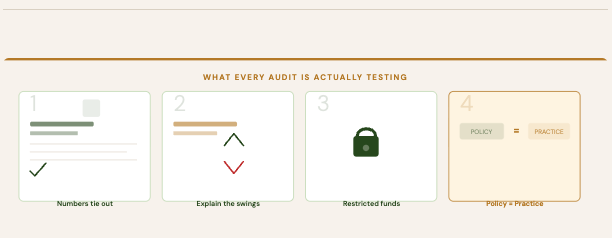
What Is Audit Fieldwork Actually Testing For?
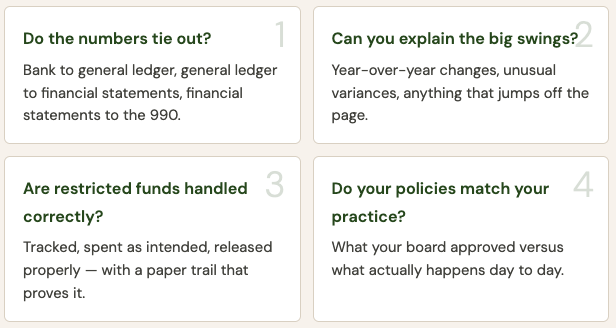
Strip away the jargon, and most audit fieldwork is testing four things:
What Documents Does a Nonprofit Auditor Actually Request?
"PBC" stands for "provided by client" — the list of documents and schedules your auditor expects ready before fieldwork starts. A typical PBC list includes:
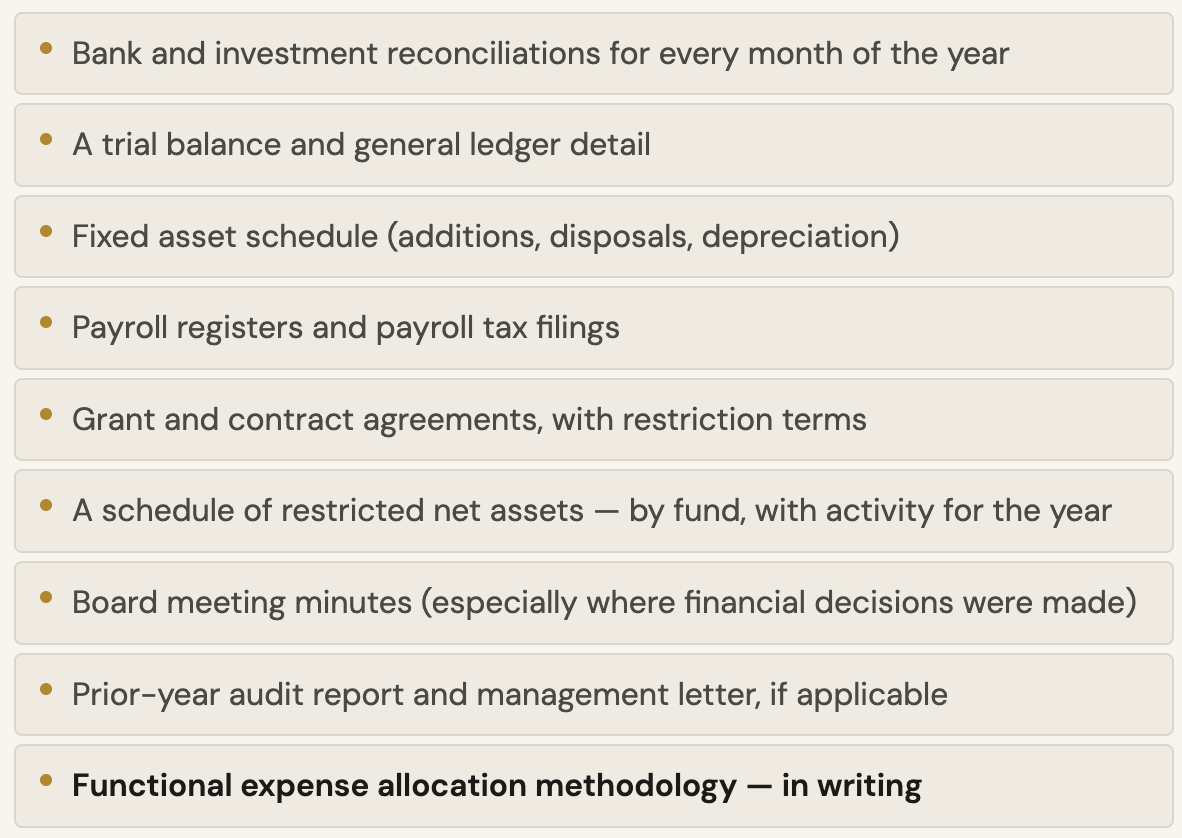
Build this list as a living folder throughout the year, not a scramble in September. If you close monthly and file as you go, the PBC list becomes an inventory — not a project.
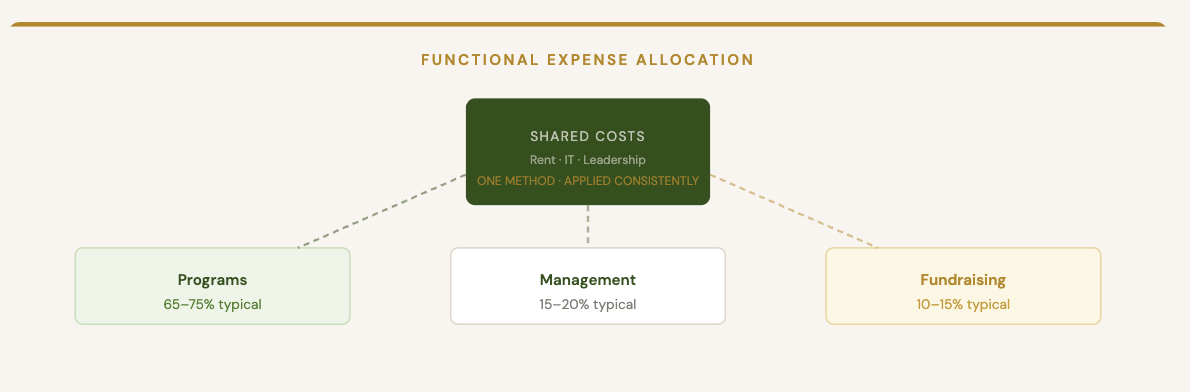
How to Handle Functional Expense Allocation Before an Audit
Auditors spend real time on functional expense allocation because it's where inconsistency hides easiest. Three questions come up almost every time:
A one-page written methodology, even an informal one, turns a back-and-forth conversation into a five-minute confirmation.
Restricted Funds: Where Audit Findings Actually Come From
Restricted funds are the area most likely to generate audit findings, because the paper trail often lives in someone's memory instead of the system. Before fieldwork, confirm:
① Clear, written restrictions
Every restricted grant or gift has a documented restriction — purpose, time period, or both. Not just in the grant agreement, but tracked in the system.
② Consistent coding
What's been spent against each restriction is coded consistently — not spread across multiple cost centers or categories that require reconstruction at year-end.
③ Releases match actual activity
Releases from restriction in the general ledger match actual program activity — not just a year-end journal entry. If a restriction was satisfied, the release was recorded in the same period the spending happened.
④ Fund-by-fund schedule ready
A schedule showing opening balance, activity, and ending balance for every restricted fund — ready to hand to the auditor, not reconstruct after they ask.
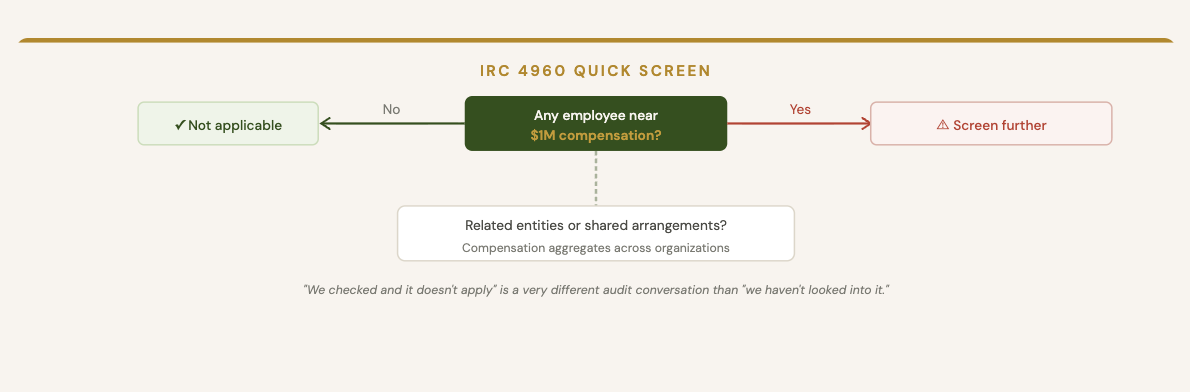
Does the New IRC 4960 Excise Tax Change Affect Your Nonprofit?
Section 4960 has existed since 2017: it's a 21% excise tax that applies when a tax-exempt organization pays a "covered employee" more than $1 million in a year. What changed under the 2025 tax law (OBBBA) is who counts as a "covered employee" in the first place.
Previously, only an organization's five highest-paid employees could trigger the tax. Starting with tax years beginning after December 31, 2025, that cap is gone — in principle, any current or former employee earning over $1 million (aggregated across your organization and related entities) can trigger it, not just the top five.
The IRS has signaled that some existing exceptions should still apply while final regulations are being written. Most small and mid-size nonprofits won't be affected. But if your organization has any employee approaching seven-figure compensation, or related entities where compensation could aggregate — a quick, documented screen before your auditor asks is worth the time.
Your Fall Audit-Readiness Plan
None of this makes the audit disappear. It makes it predictable — which, for most finance teams, is the whole goal.
"Auditors aren't looking for perfection. They're looking for consistency, documentation, and a story that holds together."