
The Board-Ready Financial Report: What to Include (and What to Skip)
If you’ve ever walked into a board meeting with a 20-page financial packet and still gotten the question:
“So… are we doing okay?” You’re not alone.
Most nonprofits don’t have a finance problem.
They have a communication problem.
A board-ready financial report isn’t just accurate—it’s useful. It helps your board:
- Understand what happened
- Understand why it happened
- Decide what to do next
Let’s build that.
What Your Board Is Really Asking
Even if they don’t phrase it this way, your board is trying to answer:
- Do we have enough cash to operate confidently?
- Are we on track with the budget?
- Are we handling restricted funds correctly?
- Are we building sustainability—or quietly burning out?
- What decisions do you need from us?
A strong report is built around these questions—not your chart of accounts.
The “Board-Ready” Financial Packet
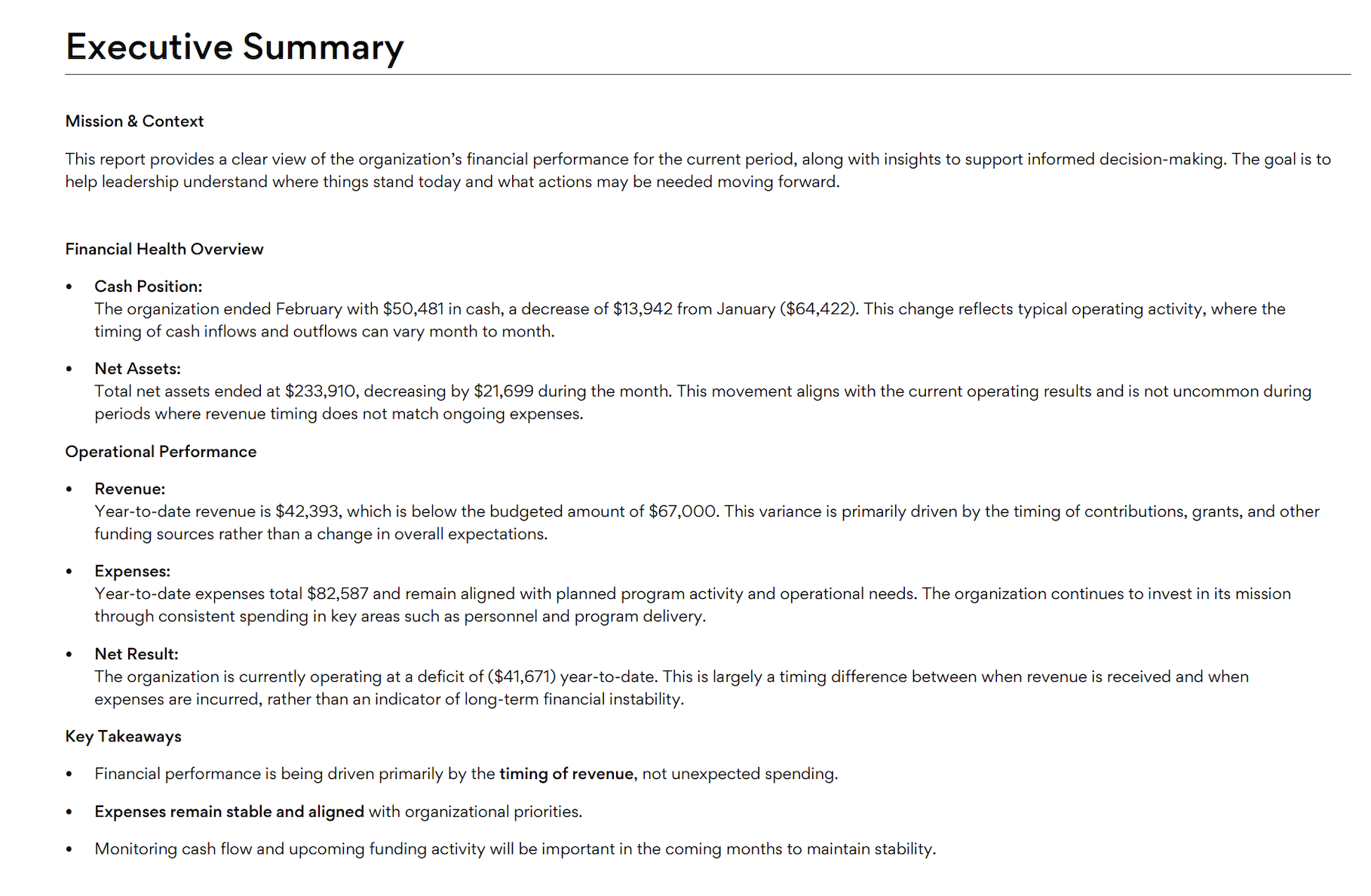
1) One-Page Dashboard Summary (Your Most Important Page)
At a glance, your board should see:
- Cash on hand + months of runway
- Budget vs. actual (YTD)
- Revenue mix (grants, donations, program income)
- Top 3 variances (with plain-English explanations)
- Restricted vs. available funds
- AR/AP snapshot (if relevant)
- 1–2 mission metrics (context matters)
If you only fix one thing this year, fix this page.
See example below.
2) Statement of Activities (With Variance Notes)
Don’t just show budget vs. actual—explain it.
Strong variance note:
“Program supplies are over budget because we served 18% more clients than projected. We are reallocating from an underspent contractor line to cover the increase.”
Weak variance note:
“Over budget due to expenses.”
Clarity builds confidence.
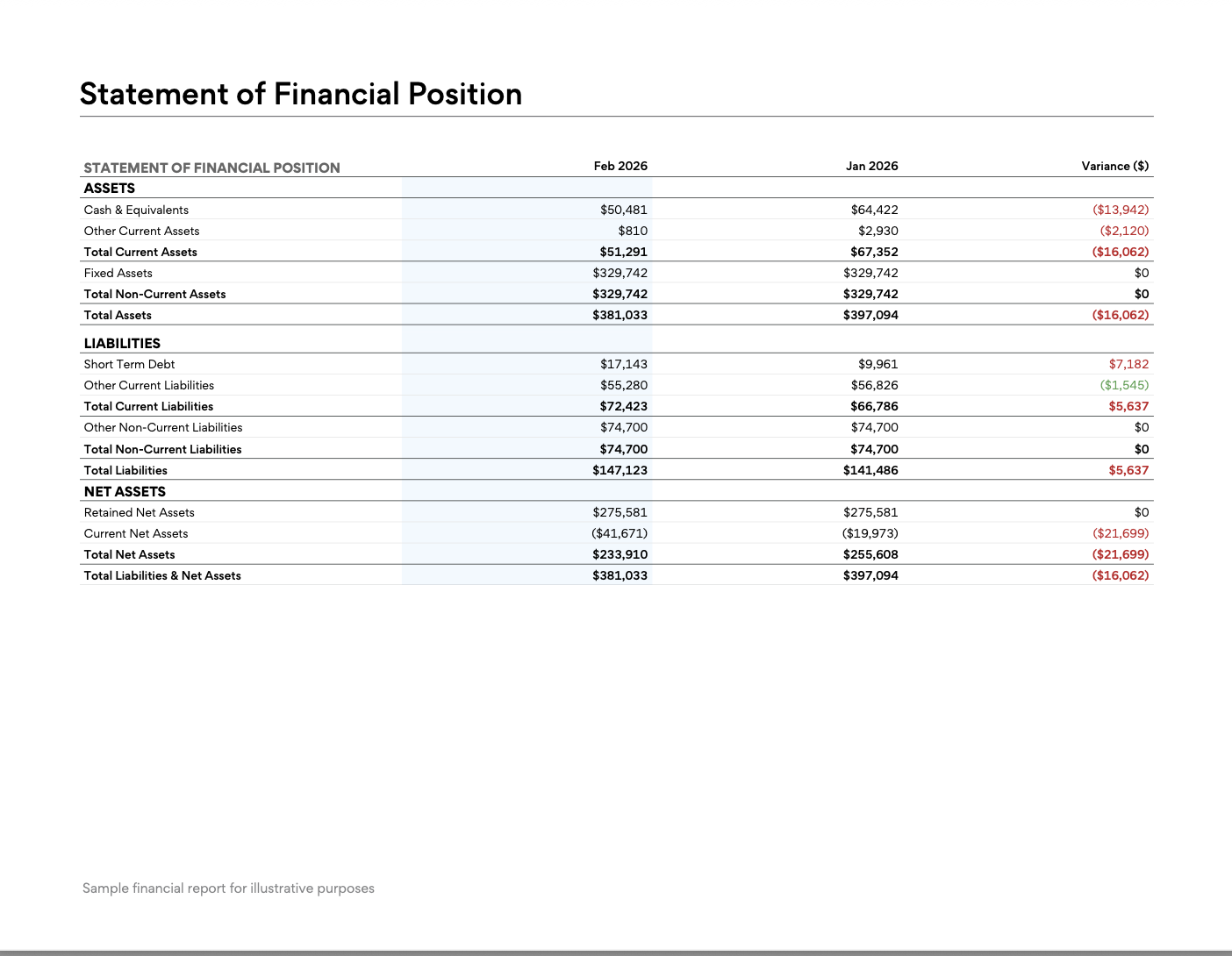
3) Statement of Financial Position (Balance Sheet)
Your board doesn’t need to memorize it—but they need help interpreting it.
Include 3 quick callouts:
- What changed significantly
- What’s restricted vs. available
- Any unusual liabilities
See example below.
4) Restricted Funds Snapshot
Keep it simple and clear:
- What funds exist
- What they’re for
- What’s been spent
- What remains
This alone can dramatically increase board trust.
5) Risks + Forecast (3 Bullets Only)
This is where finance becomes strategic:
- One risk you’re monitoring
- One key assumption
- One recommended action
6) Decisions Needed
End your report with action:
- Approvals
- Policy updates
- Budget amendments
- Signatures
This is how reporting becomes leadership.
What to Stop Sending
Move these out of your standard board packet:
- Full general ledger detail
- Vendor lists
- Reports with 40+ line items and no rollups
- Anything that requires you to explain every line
If your board can’t interpret it without you, it’s not board-ready.
Your Monthly Rhythm (So You’re Not Scrambling)
- Day 1–5: Close books + reconcile
- Day 6–8: Draft reports + variance notes
- Day 9–10: Internal review (ED + finance)
- Day 11–14: Send pre-read
- Meeting day: Focus on decisions, not decoding
Consistency turns finance into a leadership function—not a fire drill.
The Bottom Line
Your board doesn’t need more information.
They need clear, decision-ready insight.
CTA
If you want a plug-and-play version of this system:
Download the Board-Ready Finance Pack
What’s Included
- One-page dashboard template (Google Sheets–friendly)
- Fill-in-the-blank variance explanation script
- Restricted funds snapshot template
- Board meeting agenda that keeps discussions focused
- “Board questions” cheat sheet (so you’re always prepared)