
If your budget feels "off" by May, congratulations — you're running a real nonprofit, not a broken one.
Budgets are built at a point in time, with the best information you had. By the time May arrives, you've got something more valuable: actual data. Revenue came in differently than projected. A grant got delayed. A position stayed vacant longer than planned. An unexpected expense showed up.
That's not a failure. That's information — and a mid-year reforecast is how you put it to work.
This post walks you through exactly what a reforecast is, how to build one without a finance degree, and how to use it to lead your organization with confidence for the rest of the year.
What Is a Mid-Year Reforecast (and Why It's Not the Same as Changing Your Budget)?
Reforecast vs. Budget Revision — The Important Distinction
Your board-approved budget is your plan for the year. Once it's approved, the general guidance from nonprofit finance experts is clear: don't change it. Your original budget stays intact as a record of what you intended.
A reforecast is something different — it's a separate, revised projection that uses your year-to-date results plus your best current estimate for the months ahead. Think of it as a new column added alongside your original budget, not a replacement for it.
A reforecast creates a picture of where you'll likely land at year-end so you can take a pulse at different points and make adjustments. You're not rewriting history. You're updating the forecast based on what you now know.
— Nonprofit Finance Fund guidance on mid-year reforecasting
A budget revision, by contrast, means actually changing the approved plan — which typically requires board approval and is reserved for truly major, structural changes. Most mid-year adjustments don't rise to that level.
When Should You Reforecast?
The most common triggers are: a significant grant award or denial, a revenue shortfall that's been consistent for two or more months, a key staff vacancy or an unplanned hire, or an unexpected cost large enough to shift your year-end outlook. You don't need a crisis to reforecast — you need new information. And by May, you always have new information.
A good rule of thumb: reforecast quarterly at minimum. If your funding environment is volatile or you're in a growth phase, monthly reforecasting is worth the effort.
What a Reforecast Is Not
It's not an excuse to lower the bar mid-year and call it planning. It's not a spreadsheet exercise for the finance team alone. And it's not something you do once and file away. A reforecast is a living tool — it's only useful if it leads to decisions.
The Question That Changes Everything: Timing or Trend?
Here's the single most important question to ask before you touch a single line of your budget: Is this variance a timing issue, or is it a true trend? Getting this wrong is where most mid-year conversations break down — and where boards start to panic unnecessarily.
Timing Issues vs. True Trend Shifts
A timing issue is a variance that will resolve itself. A grant is delayed but awarded. A major donor pledged in Q1 but the check hasn't cleared. Payroll ran light because a position was open for six weeks but is now filled.
A true trend is different. If donor retention has been down three months in a row, that's not a timing issue — that's a signal. The practical move: label every variance as Timing, Trend, or One-time event.
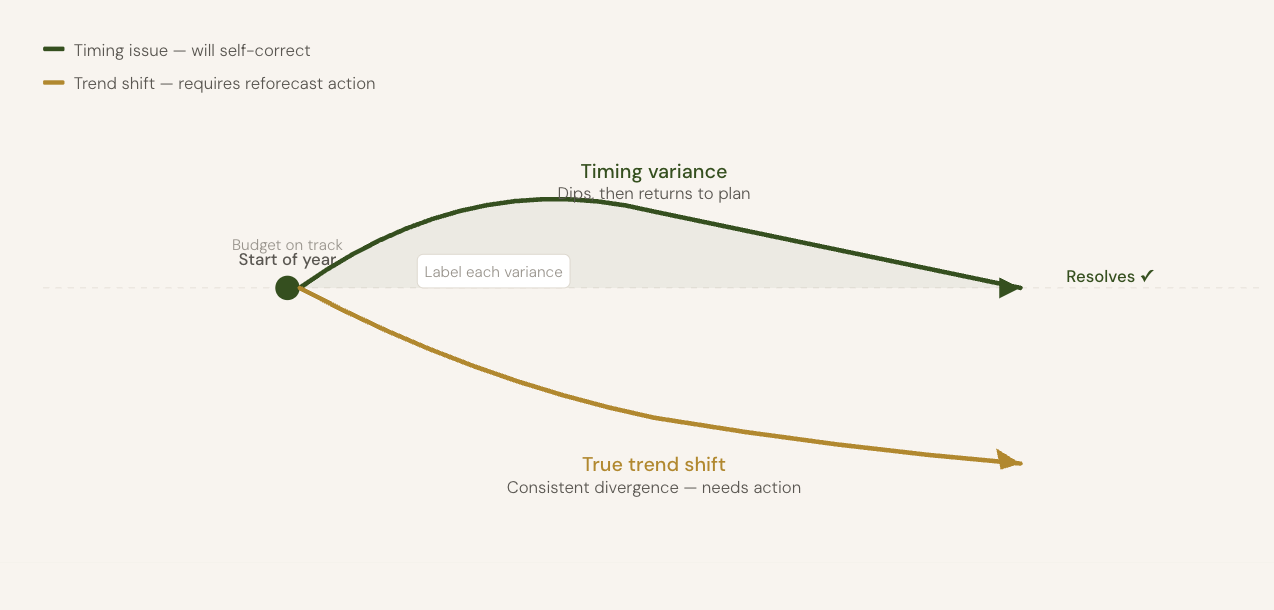
How to Label Variances So Your Board Stops Panicking
This labeling approach translates "we're off budget" into something actionable. "We're $40,000 under our individual giving budget, but $35,000 of that is a pledge timing issue from one donor we expect in June" lands very differently than a raw variance number with no context.
How to Build Your Mid-Year Reforecast in 5 Steps
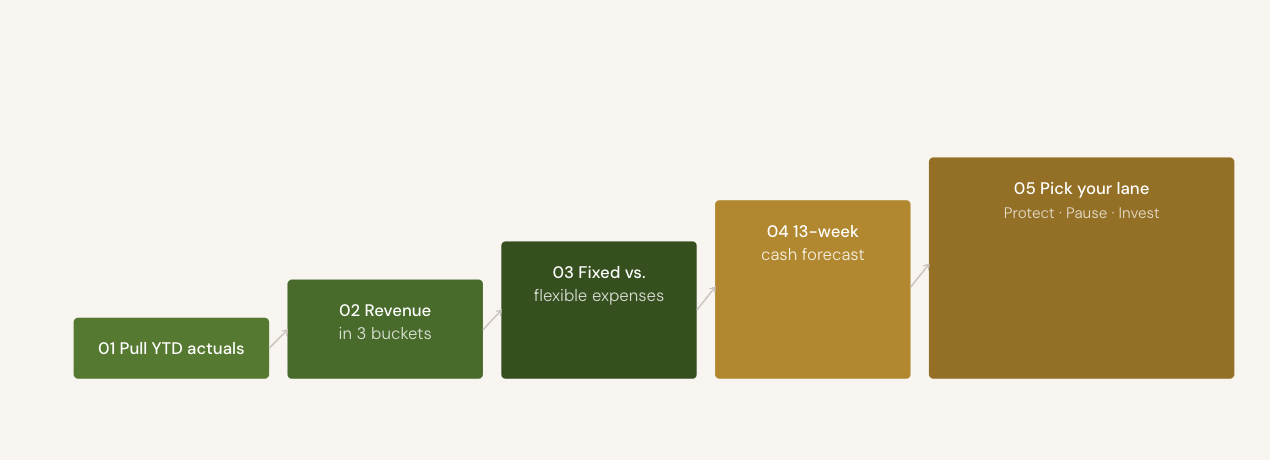
1. Pull YTD Actuals and Calculate Variance
Start with your year-to-date actuals from your accounting system. For each significant revenue and expense line, calculate the variance from budget and apply your Timing / Trend / One-time label. Don't skip the labeling step. A raw budget-vs-actual report with no context is just numbers.
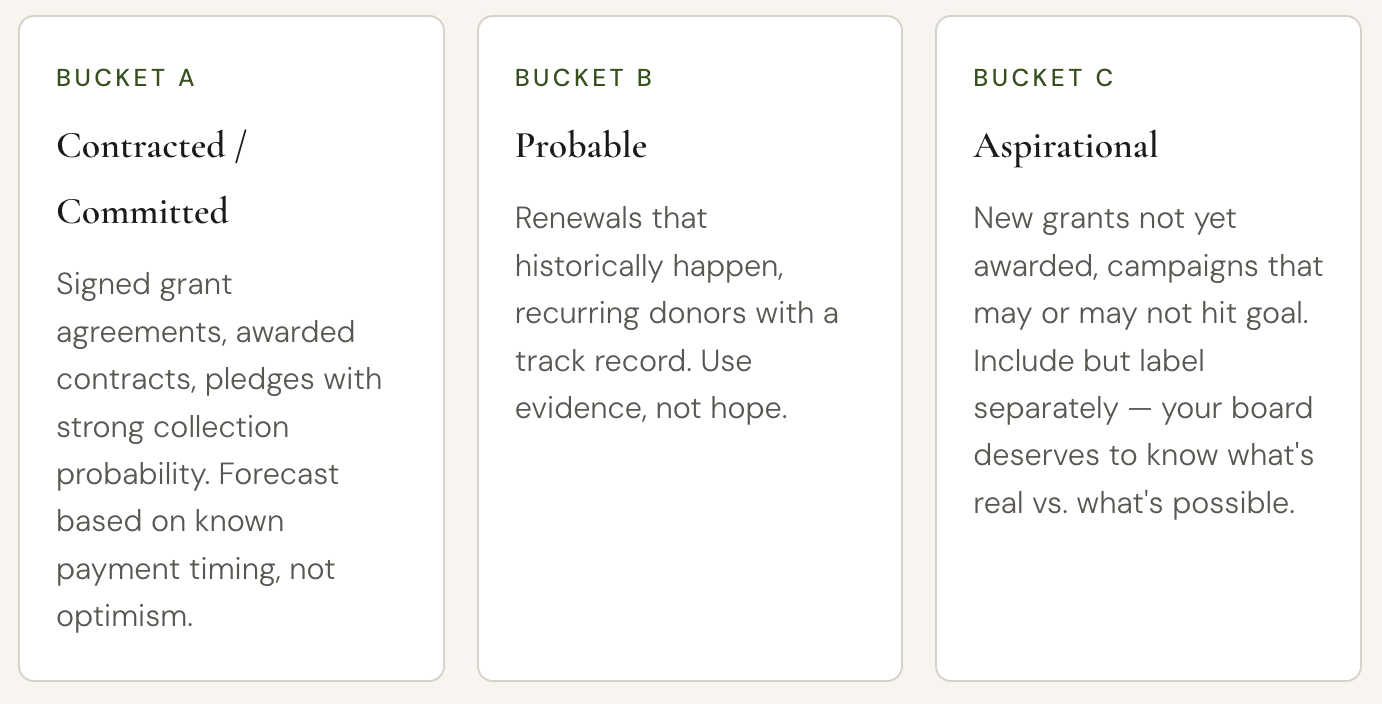
2. Reforecast Revenue in Three Buckets
Revenue forecasting gets messy when everything lives in one mental pile. Separate it into three categories:
3. Separate Fixed vs. Flexible Expenses
Fixed expenses are hard to change quickly: rent, insurance, core payroll, software contracts. Flexible expenses are where you have options: travel, discretionary contractors, program supplies, open positions, marketing.
For each flexible category, ask: Is this mission-critical right now? Does it drive revenue? What happens if we pause it for 60–90 days?
4. Build a 13-Week Cash Forecast Alongside the Annual Reforecast
This is the step most nonprofits skip, and it's the one that saves organizations from getting blindsided. Your annual reforecast can look balanced while you're about to run out of cash in six weeks.
A 13-week rolling cash flow forecast maps cash in and cash out, week by week, far enough out to act rather than react.
Identify the lowest cash week in the next quarter. That's the number you're managing toward.
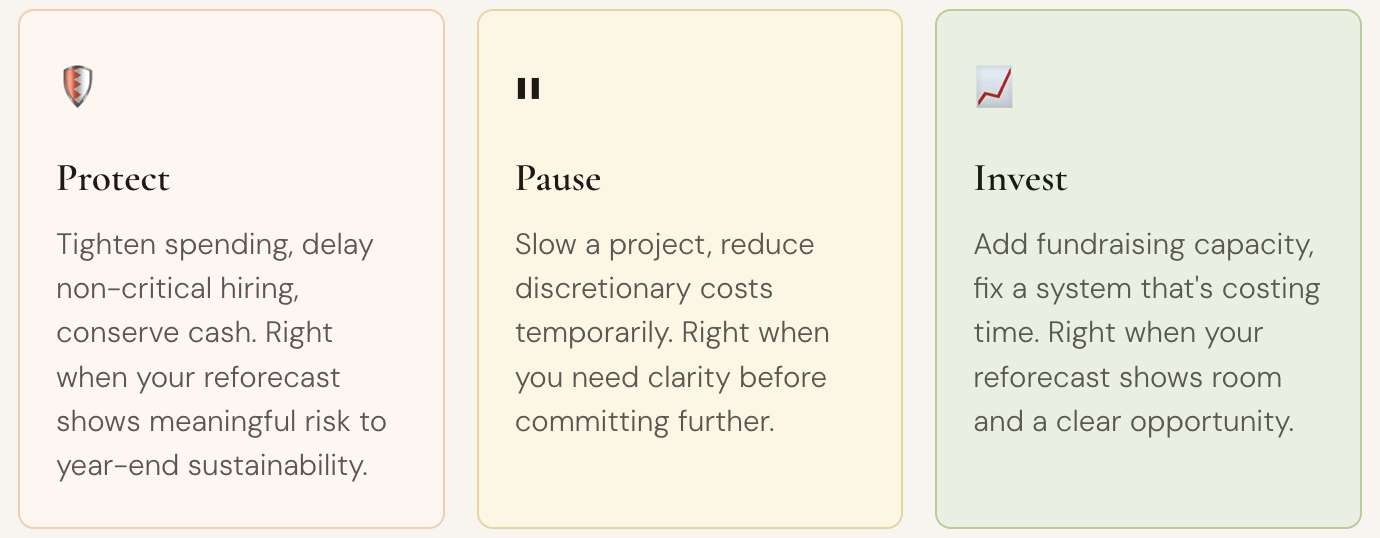
5. Decide Your Lane: Protect, Pause, or Invest
Three Mistakes That Make Mid-Year Reforecasts Useless
Forecasting Revenue at 100% When You Mean 60%
Leaders don't want to show a deficit, so aspirational revenue gets included at full value — even when the evidence doesn't support it. Separate your three revenue buckets and be honest about which category each item belongs in.
Treating the Reforecast as a Finance-Only Exercise
If only the finance director builds the reforecast in isolation, it will miss things. Program managers know which grants are coming through. Development staff know which campaigns are tracking. A mid-year reforecast should involve a brief cross-functional conversation.
Skipping the Cash Forecast and Working Only from the Budget
A balanced budget on paper can mask a cash crisis in reality. Always build the 13-week cash forecast alongside the annual reforecast. They answer different questions: the annual reforecast tells you where you're going; the cash forecast tells you whether you'll make it there.
How to Present the Reforecast to Your Board in One Page
What the board actually needs to see:
- ✓ Revised revenue forecast — what changed, why, and which bucket each item is in
- ✓ Revised expense forecast — what's fixed, what's been adjusted, what options remain
- ✓ Cash runway — months of operating expenses in unrestricted cash, plus the "tight week" from your 13-week forecast
- ✓ 1–3 decisions needed — approvals, guidance, or awareness items that require board engagement
Keep variance explanations in plain language: "Our spring gala came in $18,000 under projection due to a last-minute sponsor withdrawal. We've reclassified this as a one-time event." That's a narrative. It's what a board needs to act confidently.
Turning "We're Off Budget" Into a Leadership Conversation
The goal of the reforecast presentation isn't to report what happened. It's to lead a conversation about what to do next. When you come to your board with a reforecast, a labeled variance analysis, a cash forecast, and a recommended lane, you've transformed a financial update into a governance moment.
When the Reforecast Reveals More Than You Can Handle Alone
Sometimes a mid-year reforecast surfaces something your current team capacity can't fully address — a cash gap that needs scenario modeling, a revenue diversification problem, or a funding mix that's dangerously concentrated. These aren't signs of failure. They're signs that you've built a system clear enough to see the real picture.
If your reforecast is raising questions your internal team doesn't have bandwidth to work through, that's a reasonable moment to explore outsourced nonprofit financial support — not as a rescue, but as a strategic resource.
What a Good Mid-Year Reforecast Actually Gives You
A mid-year reforecast done well gives you three things most nonprofits don't have by May: clarity about where you actually are, options for what to do about it, and a board that's ready to make decisions rather than ask worried questions.
Your budget wasn't wrong. Reality just added new information. The reforecast is how you incorporate that information and keep leading with confidence.
Get clear. Get specific. Pick your lane. That's nonprofit financial leadership in practice.
Download the Mid-Year Reforecast Toolkit
Includes a reforecast worksheet, 13-week cash flow template, three-scenario planner, and a board update script.