
Educational only — not a substitute for accounting, audit, or legal advice specific to your organization.
Most nonprofit board members genuinely want to provide good financial oversight. The problem isn't willingness. It's usually the reports — too thick to read, too technical to interpret, or missing altogether. The goal of board-level financial reporting isn't to prove the books are clean. It's to give your board what they need to ask smart questions, make confident decisions, and represent the organization's financial health with confidence.
Six reports get you there. Here's what they are, what they show, and how to present them without putting anyone to sleep.
Why Quarterly — Not Monthly, Not Annually
Monthly reporting is too frequent for most boards — it creates noise without strategic signal. Annual reporting is too infrequent — by the time something needs attention, the window for action has often passed. Quarterly is the sweet spot: frequent enough to catch trends early, infrequent enough to be worth your board's focused attention.
Some organizations supplement with a monthly finance committee review — a smaller group of two or three board members who go deeper. That's a strong model. But the full board should be seeing the full picture at least four times a year.
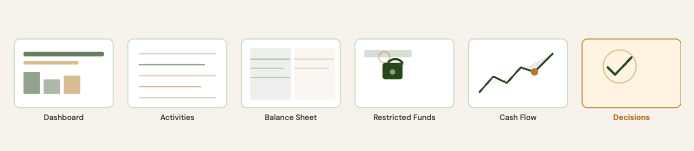
The 6 Reports Every Board Should Review Quarterly
1. The One-Page Dashboard
Every board packet should open with a single page that answers — without requiring anyone to flip to page 14 — the five questions every board member is actually asking.
Cash on hand + months of operating runway · Budget vs. actual (YTD) with a plain-English note on the biggest variance · Revenue mix snapshot · Restricted vs. unrestricted net assets — one line each · 1–2 mission metrics for context
How to present it: Walk through it in three minutes. If a board member can't interpret the dashboard without your narration, the dashboard needs work — not more narration.
2. Statement of Activities (with Variance Notes)
The Statement of Activities is the report most boards spend the most time on — and the one that most often generates confusion. The fix isn't a more detailed report. It's better variance notes.
A variance note isn't a spreadsheet annotation. It's a sentence that tells a story:
"Program supplies are over budget by $4,200 because we served 18% more clients than projected in Q2. We are reallocating from an underspent contractor line to cover this increase."
One sentence. Explains what happened, why it happened, and what you're doing about it. Board members stop asking "but why is this number red?" and start asking strategic questions.
3. Statement of Financial Position (Balance Sheet)
Most board members — even experienced ones — find the balance sheet the hardest to interpret. Three callouts make it board-readable:
- What changed significantly since last quarter — and why
- What's restricted vs. available — "we have $200K in the bank" means something very different if $180K of that is restricted
- Any unusual liabilities — deferred revenue, outstanding payroll taxes, credit card balances that look higher than normal
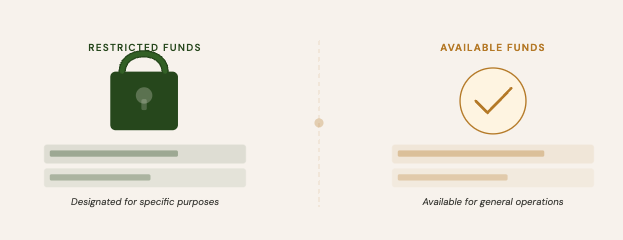
4. Restricted Funds Snapshot
This is one of the most important reports for donor-facing organizations — and one of the most commonly skipped. Boards often have no idea how many restricted funds the organization is managing, let alone whether they're being spent appropriately.
Fund name / grant name · Original amount and restrictions · Amount spent to date (this period and cumulative) · Balance remaining · Any upcoming compliance deadlines
This report builds board confidence fast — because it shows that someone is paying attention to the details that matter most to funders.
5. Cash Flow Forecast (13-Week)
The balance sheet tells you where you are. The cash flow forecast tells you where you're going. For nonprofits with lumpy revenue — grants paid in batches, fundraising events concentrated in certain months — this is often the most operationally important report on the list.
A 13-week rolling forecast doesn't need to be precise to be useful. It just needs to answer: When is the lowest cash point in the next three months? What assumptions are we making about revenue timing?
Don't walk them through every week. Identify the "tight week" and explain what you're doing about it. That's the conversation.
6. Board Decision Summary
This isn't a financial statement — it's a facilitation tool. And it might be the most underused item in any board packet.
A simple list at the end of the financial section: approvals needed, policy updates for review, budget amendments requiring a vote, any items that need a formal resolution.
When the board knows exactly what decisions are in front of them, the meeting moves efficiently. When they don't, you end up in 45 minutes of re-discussion before anyone realizes a vote is needed.
End every board financial packet with a clear "decisions needed" section. It respects the board's time and closes the loop between reporting and governance.

A Note on Presentation
Six reports sounds like a lot. In practice, a well-designed quarterly board finance presentation takes 15–20 minutes when the materials are prepared well.
If your board regularly spends more than 30 minutes on finance at each meeting, the reports may be doing too much work that the presenter should be doing instead.
Your August Action Plan
Six Things to Do This Month
- Audit your current board packet — does it answer the five core questions on page one?
- Add variance notes to your Statement of Activities — three sentences, not bullet lists of numbers
- Build a restricted funds snapshot if you don't have one
- Add a 13-week cash forecast to your next quarterly packet — even a simple version
- End your next board meeting packet with a "decisions needed" section
- Time your next finance presentation — if it takes more than 20 minutes, the packet needs editing, not expanding
"Your board wants to do this job well. Give them the right tools."